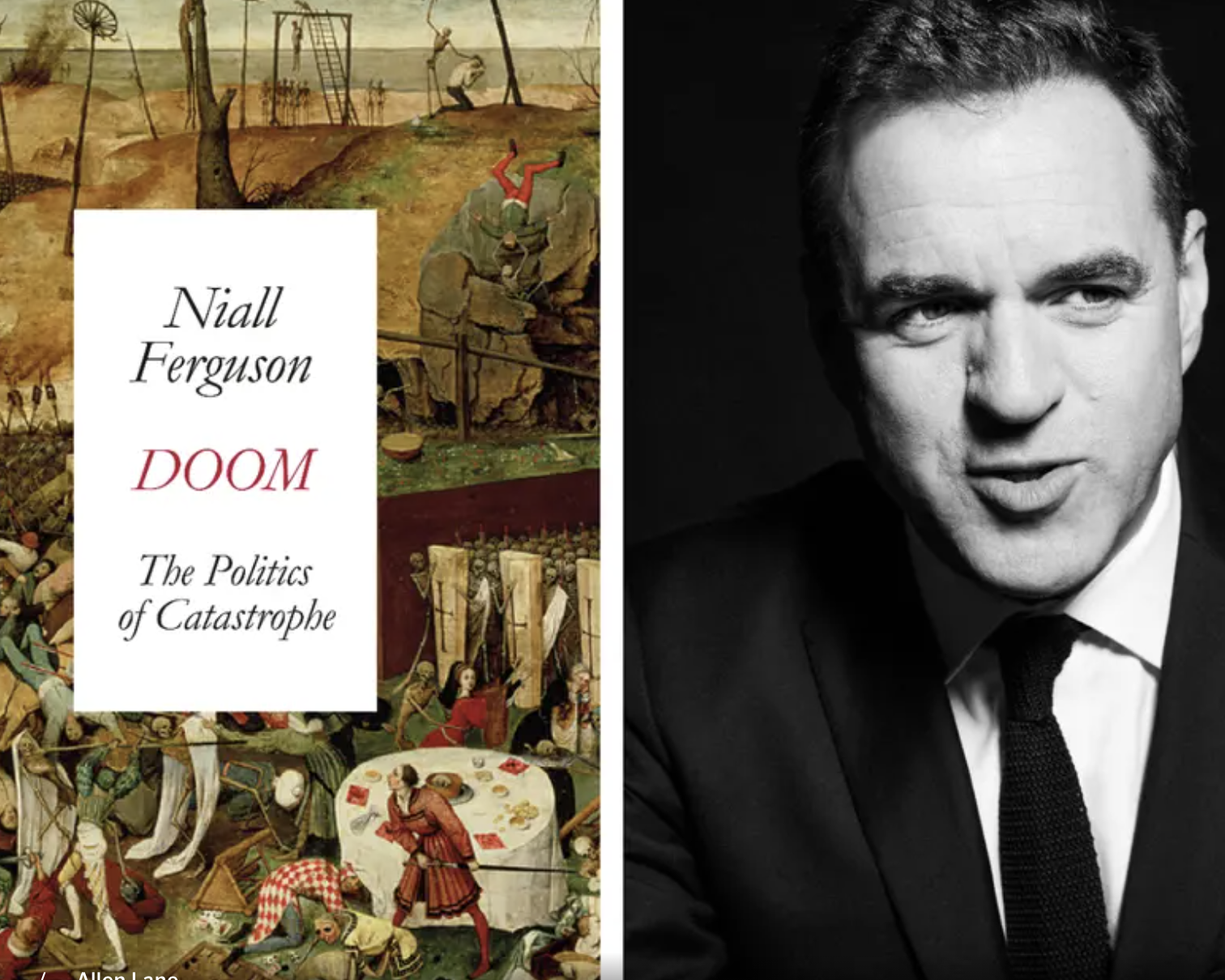
Doom: The Politics of Catastrophe by Niall Ferguson review
(Evening Standard) – From plagues and volcanic eruptions to the current Covid pandemic, mankind has always been faced with catastrophes.
Thought Leader: Niall Ferguson


Niall Ferguson argues that the media reaction to President Trump’s new National Security Strategy (NSS) says more about elite assumptions than about the document itself. While headlines framed the strategy as hostile, incoherent, or anti-European, Ferguson contends that this outrage reflects a misunderstanding of both how such documents are written and what they actually represent.
Ferguson opens by describing the NSS as the product of bureaucratic “stramash”—a noisy, multi-agency process involving numerous officials, revisions, and competing priorities. Drawing on Henry Kissinger’s famous insight that there is no single, coherent “American foreign policy,” Ferguson argues that strategy documents are compromises, not operating manuals. They are not blueprints for action, nor expressions of a unified governmental voice—and often not closely read by the president himself.

Much of the backlash, Ferguson suggests, stems from the NSS’s explicit rejection of long-standing foreign policy orthodoxies. The document repudiates the post-Cold War idea of the United States as an “indispensable nation” responsible for policing the globe, arguing instead that these ambitions overstretched American resources and hollowed out the domestic economic base. It also breaks with a century of elite consensus by placing the Western Hemisphere—not Europe—at the top of U.S. strategic priorities.
Ferguson highlights the strategy’s emphasis on Latin America, particularly Venezuela, where the NSS signals a renewed assertion of U.S. influence and a willingness to act against what it describes as chronic wrongdoing, criminal networks, and growing Chinese economic penetration. He frames this shift as long overdue, especially given decades of U.S. disengagement from the region.
On Europe, Ferguson acknowledges the document’s stark language but argues that its critique reflects real concerns outlined directly in the text: weak military capacity, demographic decline, internal political constraints, and social fragmentation. While controversial, Ferguson notes that these assessments are difficult to dismiss outright and raise legitimate questions about Europe’s long-term reliability as a strategic partner. The NSS nevertheless affirms continued U.S. engagement in European security, including efforts to stabilize relations with Russia and seek an end to the war in Ukraine.
Beyond Europe and the Western Hemisphere, Ferguson emphasizes that much of the NSS is strikingly conventional. It reiterates familiar U.S. goals in the Middle East—preventing regional domination and avoiding prolonged wars—and focuses on deterring China, particularly with respect to Taiwan, while encouraging greater burden-sharing among Asian allies. The document also stresses rebuilding America’s defense industrial base and ensuring U.S. leadership in critical technologies such as AI, biotechnology, and quantum computing.

Ferguson concludes that critics have missed the larger point: the NSS is not a radical departure but a blend of established traditions—Nixonian realism, Reagan-era deterrence, and even elements of liberal “soft power.” Rather than a doctrinal manifesto, it is the messy byproduct of America’s fractured foreign-policy machinery. The global obsession with decoding its deeper meaning, Ferguson argues, overlooks a simple reality: U.S. foreign policy is shaped less by official texts than by ongoing institutional struggle inside “the room where it happens.”
Read Niall Ferguson’s full analysis and explore his argument in depth here.
WWSG exclusive thought leader Sir Niall Ferguson is one of the world’s foremost historians of economics, international relations, and global power. His incisive analysis illuminates the geopolitical forces and economic undercurrents shaping the 21st century. From great power competition to emerging security challenges, Ferguson offers unparalleled historical context and strategic insight — helping global leaders, policymakers, and business executives anticipate what lies ahead. To invite Sir Niall Ferguson to your next event, contact WWSG
Doom: The Politics of Catastrophe by Niall Ferguson review
(Evening Standard) – From plagues and volcanic eruptions to the current Covid pandemic, mankind has always been faced with catastrophes.
Thought Leader: Niall Ferguson
Time to end secret data laboratories—starting with the CDC
The American people are waking up to the fact that too many public health leaders have not always been straight with them. Despite housing treasure…
Thought Leader: Marty Makary
Scott Gottlieb: How well can AI chatbots mimic doctors in a treatment setting?
This is an Op-ed by WWSG exclusive thought leader, Dr. Scott Gottlieb. Many consumers and medical providers are turning to chatbots, powered by large language…
Thought Leader: Scott Gottlieb